Healthy Schools
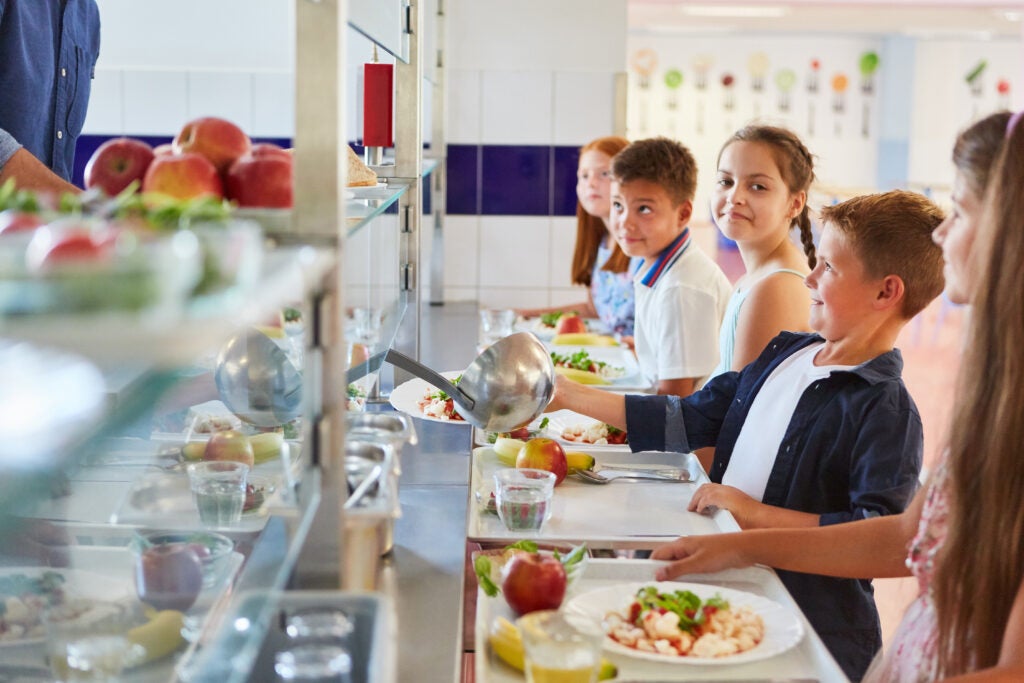
Schools are in a unique position to promote healthy eating and physical activity, with more than 95% of U.S. youth aged 5-17 years old attending school outside of the home. Schools can implement policies and practices that encourage healthy eating and physical activity during the school day, and can also help children and adolescents establish lifelong healthy patterns.
Healthy Eating During the School Day
Policies and programs guiding what foods and beverages are available in schools provide an important opportunity to improve child health. This is especially important for children from households with lower incomes and children who are members of racial/ethnic minority groups (who, on average, have less access to healthy food, poorer dietary quality, and higher risk for obesity compared to other children). [1]
School meals and competitive foods and beverages
In the U.S., federal assisted meal programs administered by the United States Department of Agriculture provide nutritionally adequate breakfasts, lunches, and afterschool snacks to children during the school year. The School Breakfast Program (SBP) serves meals to 14.6 million children, and the National School Lunch Program (NSLP) provides lunches and after-school snacks to more than 30 million children; 22 million receive those meals for free or at a reduced price. [2] Lower-income children participate in these programs at higher rates than other children, and can receive free or reduced-priced meals. [3]
The Healthy Hunger Free Kids Act (HHFKA) of 2010 authorized funding and set policies to improve the nutritional quality of food and beverages served to children through the SBP and NSLP. [4] HHFKA regulations required meal patterns for breakfast and lunch to increase fruits and vegetables and limit starchy vegetables, create age-specific recommended serving sizes, serve only low-fat or fat-free milk, and serve more whole grains, among other standards. [5] The HHFKA also, for the first time, established nutrition standards for competitive food and beverages sold outside of school meal programs as a la carte, from vending machines, or school stores. These “Smart Snacks” guidelines eliminated almost all sugary beverages, and placed limits on calories, sodium, and saturated fat and sugars on snacks. [6]
Implementation of HHFKA has been a major advance for child nutrition, [7-9] and several studies have found its implementation was associated with significant decreased risk of obesity among school-aged children and may have been particularly impactful for students in poverty, who tend to benefit the most from NSLP/SBP. [10-12] In the U.S., Canada, and the United Kingdom, nutrition standards for competitive food and beverages and school meals in the and have demonstrated positive health impacts, including reducing consumption of sugary beverages and unhealthy snacks, and increasing fruit intake. [13]
Increasing participation in school meals
To ensure that children who would benefit most from SBP and NSLP have access to these programs, it is important to consider how to increase student participation in school meals. One promising approach is the adoption of universal free school meals (UFSM) policies. After a UFSM policy was temporarily introduced nationwide in 2020 during the COVID-19 pandemic, several states passed legislation to continue funding the program within their own states, and many others are considering adopting a UFSM model. UFSM models are associated with increased participation in school meals and reduced obesity risk. [14] In states without UFSM, there are more localized options for increasing access to school meals. The Community Eligibility Provision (CEP) is a non-pricing meal service option for schools and school districts in low-income areas that allow them to serve breakfasts and lunches at no cost to all enrolled students without collecting household application. Schools that adopt CEP are reimbursed based on the participation in other food assistance programs such as the Supplemental Nutrition Assistance Program and Temporary Assistance for Needy Families. Students in CEP districts would be provided free, healthy meals consistent with the HHFKA guidelines, and significantly reduce the administrative burden for school districts. [15]
Direct provision of fresh fruits and vegetables
In the U.S., the Fresh Fruit and Vegetable Program (FFVP) is another federally assisted program that provides free fresh fruits and vegetables to elementary school children during the school year. FFVP introduces children to new and different varieties of fresh fruits and vegetables, with the goal of increasing overall acceptance and consumption. FFVP prioritizes schools with the highest percentage of children eligible for free and reduced priced meals. [16] Other countries have also implemented direct provisions of fruits and vegetables in schools, including Canada, Denmark, Netherlands, Norway, and the United Kingdom. A meta-analysis of programs in these countries and the U.S. demonstrated that direct provision policies significantly increased fruit and vegetable intake. [13]
Recommendations for school meals and competitive foods in schools
- Provide competitive foods and beverages and school meals that meet nutrition standards
- Increase participation in school meals through programs such as Community Eligibility Provision and Universal School Breakfast
- States should implement nutrition standards that strengthen the federal standards
- Direct provision of healthful food and beverages such as fruits and vegetables
- Increase financial support for school meal programs from federal, state, and local governments
Best practice guidance for school meals and competitive foods in schools
- Give students adequate time to eat
- Encourage staff to model healthy eating
- Incorporate nutrition education into school meal programs
- Ensure that food served at classroom parties and school functions, including fundraisers, meets competitive food standards
- Limit marketing of unhealthy foods
- School garden programs including nutrition and gardening education and hands-on gardening experiences
- Invest in cafeteria facilities to store, prepare, and display healthy foods
- Train food service staff in health food preparation techniques
- Centers for Disease Control and Prevention – Healthy Schools: School Nutrition Environment
- Robert Wood Johnson Foundation – State of Childhood Obesity: School Meals
- ChangeLab Solutions – Marketing Matters: Strategies to reduce unhealthy food & beverage marketing to young children
Drinking Water Access During the School Day
Providing clean, safe drinking water in schools helps increase students’ overall water intake, maintain hydration, and reduce calorie intake if substituted for sugary drinks. [17-19] The HHFKA requires schools participating in the School Breakfast or and National School Lunch Program to make water available to students during meal times for free. [20] One study found that installation of water jet dispensers on school cafeteria lunch lines was a cost-effective strategy for preventing cases of childhood obesity. [21]
- Centers for Disease Control and Prevention – Increasing Access to Drinking Water in Schools
- ChangeLab Solutions – Drinking Water Access in Schools
Physical Activity During the School Day
Children require at least 60 minutes of moderate to vigorous physical activity each day. Schools can help children get the recommended amount of daily physical activity by offering more frequent, higher quality and more active physical education and recess, and by promoting physical activity throughout the day. [22-26]
Active physical education
Health organizations recommend that schools provide 150 minutes per week of instructional physical education for school children and 225 minutes per week for middle and high school students throughout the school year. [27,28] In 2014, only 15% of elementary, 9% of middle, and 6% of U.S. high schools require students to take physical education classes on at least 3 days per week. [29] Furthermore, children often spend less than half of their time in physical education classes being physically active. [24,30] Active physical education focuses on making the time that children spend in class more active. Improving the quality of physical education classes will help children get more physical activity and encourage them to develop healthy habits.
Best practice guidance for physical activity during the school day
- Provide daily physical education to children in grades K-12
- Provide a minimum minutes per week of participation in physical education
- Adopt physical education standards and curriculum
- Ensure that children spend most of their physical education time being physically active
- Hire licensed physical education teachers and offer them ongoing training
- Make sure that physical education requirements are not waived for other physical or academic activities
- Prohibit schools and districts from using physical activity as a form of punishment
- Centers for Disease Control and Prevention: Physical Education Curriculum Analysis Tool
- The Society of Health and Physical Educators (SHAPE America) provides programs, resources, and advocacy that support and inclusive, active and healthier school culture
Physical activity during recess
Daily recess during the school day is a relatively easy and low-cost way to help children be physically active. In addition to offering recess, it is important that the time that children spend in recess periods is physically active time. Unfortunately, since the mid-2000s, up to 40% of U.S. school districts have reduced or eliminated recess time. [21,31] Ways to increase physical activity during recess time include providing structured physical activity, the installation of playground markings, and/or the provision of portable play equipment. [32]
Best practice guidance for recess during the school day
- Provide all k-12 students with recess daily
- Provide schools and students with adequate spaces, facilities, equipment, and supplies for recess
- Ensure that spaces and facilities for recess meet or exceed recommended safety standards
- Do not exclude students from recess for disciplinary reasons or academic performance in the classroom
- Schedule morning recess before lunch
- Provide staff members who lead or supervise recess with ongoing professional development
- Centers for Disease Control and Prevention and SHAPE America:
- Strategies for Recess in Schools
- Recess Planning in Schools: A Guide to Putting Strategies for Recess into Practice
Active classrooms
Incorporating classroom physical activity can take place at any time and occurs at one or several brief periods during the school day. Physical activity in the classroom can be integrated into academic instruction or providing breaks from instruction designed for physical activity. In 2016, only 11% of U.S. school districts required elementary schools to provide regular classroom physical activity breaks; this was even lower for middle schools (8%) and high schools (2%). [33]
Best practice guidance for classroom physical activity in schools
- Integrate physical activity into planned academic instruction to reinforce academic concepts [34,35]
- Provide physical activity breaks outside of planned academic instruction
- Use classroom physical activity as a way to reinforce skills learned in physical education
- Ensure that barriers to classroom physical activity, such as lack of equipment or available space, are minimized.
- Do not withhold classroom physical activity from students as a disciplinary approach
- Provide teachers with ongoing professional development on classroom physical activity
- National Network of Public Health Institutes, Health Resources in Action, and Centers for Disease Control and Prevention – Integrate Classroom Physical Activity in Schools: A Guide for Putting Strategies into Practice.
- Springboard to Active Schools – Integrate Classroom Physical Activity in Schools
- Centers for Disease Control and Prevention – Classroom Physical Activity
- Eat Well & Keep Moving: An Interdisciplinary Elementary Curriculum Nutrition and Physical Activity (Third Edition)
- Planet Health: An Interdisciplinary Curriculum for Teaching Middle School Nutrition and Physical Activity (Second Edition)
A comprehensive school physical activity program
A Comprehensive School Physical Activity Program is the development, implementation, and evaluation of strategies to increase physical activity during the school day. With active physical education, active recess, and movement breaks in the classroom. [22] A coordinated effort in schools to help all students meet recommended levels of physical activity would help children grain skills and confidence to make regular physical activity a lifelong habit.
The 5 Components of a Comprehensive School Physical Activity Program [22]
- Physical Education
- Physical Activity During School: Recess and Movement Breaks in the Classroom
- Family and Community Engagement
- Staff Involvement
- Physical Activity Before and After School
Related resources
Resources to support this effort are provided by the Centers for Disease Control and Prevention:
- Increasing Physical Education and Physical Activity: A Framework for Schools 2019
- Comprehensive School Physical Activity Program
Multi-component School Based Programs and Policies to Improve Diet and Physical Activity
Schools play an important role in improving the dietary and physical activity behaviors of students by implementing policies and practices that support healthy eating and physical activity. Multi-component school-based interventions targeting both diet and physical activity may help prevent excess weight gain among children. [36-40]
The Centers for Disease Control and Prevention created the School Health Guidelines that are the foundation for developing, implementing, and evaluating healthy eating and physical activity policies and programs for students during the school day. Resources for the School Health Guidelines are provided by the Centers for Disease Control: School Health Guidelines to Promote Healthy Eating and Physical Activity, and School Health Guidelines.
The 9 School Health Guidelines [40]
- Healthy Eating and Physical Activity
- School Environments
- Quality School Meal Program
- Comprehensive Physical Activity
- Health Education
- Health, Mental Health, and Social Services
- Partner with Families and Community members
- School Employee Wellness Program
- Certified and Qualified Staff
Intervention highlight
A systematic review across high-income countries of strategies to prevent childhood overweight and obesity found that school-based intervention with combined diet and physical activity components and a home element had the greatest intervention effects for at least one adiposity-related outcome. The findings support recommendations that schools should be a focal point for obesity prevention efforts. [36]
School Wellness Policies
Starting in 2006, U.S. schools participating in NSLP and/or SBP were required to adopt and implement a wellness policy that included standards for nutrition education, school meals and competitive foods, and physical activity. Districts with strong, comprehensive policies were more successful at implementing such policies at the school level. [41] Furthermore, state wellness policy requirement laws have been associated with successful school district wellness policy implementation, highlighting the role of state laws and district policies in working together to ensure healthy eating and physical activity strategies are implemented in schools. [42] Strong school wellness policies result in improved competitive food and beverage environments and physical activity practices, and may significantly reduce the risk of adolescent obesity. [43-48]
- Centers for Disease Control and Prevention – Improving School Health
- No Kids Hungry Center for Best Practice: School Meals
- Alliance for a Healthier Generation: Creating healthy learning environments that empower students to thrive physically, emotionally, and academically
- Food Research and Action Center (FRAC) – Healthy School Meals for All
- USDA Food and Nutrition Service Local School Wellness Policies
International school food standards and physical activity strategies
- Food and Agriculture Organization of the United Nations: – Nutrition guidelines and standards for school meals: A report from 33 low and middle income countries
- HEPS Guidelines – Promoting healthy eating and physical activity in schools
- Food and Agriculture Organization of the United Nations – Legislating for Adequate Food and Nutrition in Schools
- World Food Programme – Smart School Meals
- World Health Organization – Promoting Physical Activity in the Education Sector
Related
- Healthy Food Environment
- Active Communities
- Healthy Spaces for Youth
- Healthy Child Care Settings
- Packing a Healthy Lunchbox
- Kid’s Healthy Eating Plate
- Why School Meals Matter
- Hales CM, Carroll MD, Fryar CD, Ogden CL. Prevalence of Obesity Among Adults and Youth: United States, 2015–2016. NCHS data brief, no 288. Hyattsville, MD: National Center for Health Statistics. NCHS Data Brief. 2017;(288):1-8
- United States Department of Agriculture Food and Nutrition Service. National School Lunch Program. Accessed March 31, 2023.
- Fox MK, Gearan E. School Nutrition and Meal Cost Study: Summary of Findings. Mathematica Policy Research; 2019 Apr 23.
- Schwartz C, Wootan MG. How a public health goal became a national law: the Healthy, Hunger-Free Kids Act of 2010. Nutrition today. 2019 Mar 1;54(2):67-77.
- U.S. Department of Agriculture Food and Nutrition Services. Nutrition Standards in the National School Lunch and School Breakfast Programs; Final Rule. Fed Regist. 2012;77(17):4088-4167.
- US Department of Agriculture Food and Nutrition Service. National School Lunch Program and School Breakfast Program: Nutrition Standards for All Foods Sold in School as Required by the Healthy, Hunger-Free Kids Act of 2010. Vol 81.; 2016:50132-50151.
- Au LE, Gurzo K, Gosliner W, Webb KL, Crawford PB, Ritchie LD. Eating school meals daily is associated with healthier dietary intakes: The Healthy Communities Study. Journal of the Academy of Nutrition and Dietetics. 2018 Aug 1;118(8):1474-81.
- Johnson DB, Podrabsky M, Rocha A, Otten JJ. Effect of the Healthy Hunger-Free Kids Act on the nutritional quality of meals selected by students and school lunch participation rates. JAMA pediatrics. 2016 Jan 1;170(1):e153918-.
- Gearan EC, Monzella K, Jennings L, Fox MK. Differences in diet quality between school lunch participants and nonparticipants in the United States by income and race. Nutrients. 2020 Dec 19;12(12):3891.
- Kenney EL, Barrett JL, Bleich SN, Ward ZJ, Cradock AL, Gortmaker SL. Impact Of The Healthy, Hunger-Free Kids Act On Obesity Trends: Study examines impact of the Healthy, Hunger-Free Kids Act of 2010 on childhood obesity trends. Health Affairs. 2020 Jul 1;39(7):1122-9.
- Chandran A, Burjak M, Petimar J, Hamra G, Melough MM, Dunlop AL, Snyder BM, Litonjua AA, Hartert T, Gern J, Alshawabkeh AN. Changes in body mass index among school-aged youths following implementation of the Healthy, Hunger-Free Kids Act of 2010. JAMA pediatrics. 2023 Apr 1;177(4):401-9.
- Kinderknecht K, Harris C, Jones-Smith J. Association of the healthy, hunger-free kids act with dietary quality among children in the US national school lunch program. JAMA. 2020 Jul 28;324(4):359-68.
- Micha R, Karageorgou D, Bakogianni I, Trichia E, Whitsel LP, Story M, Peñalvo JL, Mozaffarian D. Effectiveness of school food environment policies on children’s dietary behaviors: A systematic review and meta-analysis. PloS one. 2018 Mar 29;13(3):e0194555.
- Localio AM, Knox MA, Basu A, Lindman T, Walkinshaw LP, Jones-Smith JC. Universal Free School Meals Policy and Childhood Obesity. Pediatrics. 2024 Apr 1;153(4):e2023063749.
- United States Department of Agriculture Food and Nutrition Service. Community Eligibility Provision. Accessed April 3, 2023.
- United States Department of Agriculture Food and Nutrition Service. Fresh Fruit and Vegetable Program. Accessed April 3, 2023.
- Centers for Disease Control and Prevention. Water Access in Schools. Accessed 07/05/21.
- Wang YC, Ludwig DS, Sonneville K, Gortmaker SL. Impact of change in sweetened caloric beverage consumption on energy intake among children and adolescents. Archives of pediatrics & adolescent medicine. 2009 Apr 6;163(4):336-43.
- Muckelbauer R, Libuda L, Clausen K, Toschke AM, Reinehr T, Kersting M. Promotion and provision of drinking water in schools for overweight prevention: randomized, controlled cluster trial. Pediatrics. 2009 Apr 1;123(4):e661-7.
- Department of Agriculture, Food and Nutrition Service. Healthy Hunger-Free Kids Act. Accessed 07/05/21.
- Kenney EL, Cradock AL, Long MW, Barrett JL, Giles CM, Ward ZJ, Gortmaker SL. Cost‐effectiveness of water promotion strategies in schools for preventing childhood obesity and increasing water intake. Obesity. 2019 Dec;27(12):2037-45.
- Centers for Disease Control and Prevention. Physical Education and Physical Activity. Accessed 07/05/21.
- US Department of Health and Human Services. Physical Activity Guidelines for Americans Midcourse Report Subcommittee of the President’s Council on Fitness, Sports & Nutrition. Physical Activity Guidelines for Americans Midcourse Report: Strategies to Increase Physical Activity Among Youth. Washington, DC. 2012.
- Institute of Medicine. 2013. Educating the Student Body: Taking Physical Activity and Physical Education to School. Washington, DC: The National Academies Press.
- Cradock AL, Barrett JL, Kenney EL, Giles CM, Ward ZJ, Long MW, Resch SC, Pipito AA, Wei ER, Gortmaker SL. Using cost-effectiveness analysis to prioritize policy and programmatic approaches to physical activity promotion and obesity prevention in childhood. Preventive medicine. 2017 Feb 1;95:S17-27.
- Robert Wood Johnson Foundation. The State of Childhood Obesity; Helping all children grow up healthy. Accessed 07/05/21.
- Society of Health and Physical Educators. Physical Education Guidance Documents and Position Statements. Accessed 07/05/21.
- American Heart Association. Physical education in public schools (fact sheet). Washington, DC: American Heart Association Advocacy Department. Accessed 07/05/21.
- Centers for Disease Control and Prevention. Results from the School Health Policies and Practices Study 2014. Atlanta, GA: U.S. Department of Health and Human Services;2015.
- Hollis JL, Williams AJ, Sutherland R, Campbell E, Nathan N, Wolfenden L, Morgan PJ, Lubans DR, Wiggers J. A systematic review and meta-analysis of moderate-to-vigorous physical activity levels in elementary school physical education lessons. Preventive medicine. 2016 May 1;86:34-54.
- Robert Wood Johnson Foundation. The state of play: Gallup survey of principals on school recess. 2010.
- Council on School Health, Murray R, Ramstetter C, Devore C, Allison M, Ancona R, Barnett S, Gunther R, Holmes BW, Lamont J, Minier M. The crucial role of recess in school. Pediatrics. 2013 Jan 1;131(1):183-8.
- Centers for Disease Control and Prevention. School Health Policies and Practices Study (SHPPS): Results from the school health policies and practices study. 2016.
- Carter J, Wiecha JL, Peterson KE, Nobrega S, Gortmaker SL. Planet Health: An Interdisciplinary Curriculum for Teaching Middle School Nutrition and Physical Activity (Second Edition). Champaign, Illinois: Human Kinetics; 2007.
- Cheung LWY, Dart H, Kalin S, Otis B, Gortmaker SL. Eat Well & Keep Moving: An Interdisciplinary Elementary Curriculum Nutrition and Physical Activity (Third Edition). Human Kinetics, Champaign, Illinois, 2016.
- Bleich SN, Vercammen KA, Zatz LY, Frelier JM, Ebbeling CB, Peeters A. Interventions to prevent global childhood overweight and obesity: a systematic review. The Lancet Diabetes & endocrinology. 2018 Apr 1;6(4):332-46.
- Brown T, Summerbell C. Systematic review of school‐based interventions that focus on changing dietary intake and physical activity levels to prevent childhood obesity: an update to the obesity guidance produced by the National Institute for Health and Clinical Excellence. Obesity reviews. 2009 Jan;10(1):110-41.
- Mozaffarian D, Afshin A, Benowitz NL, Bittner V, Daniels SR, Franch HA, Jacobs Jr DR, Kraus WE, Kris-Etherton PM, Krummel DA, Popkin BM. Population approaches to improve diet, physical activity, and smoking habits: a scientific statement from the American Heart Association. Circulation. 2012 Sep 18;126(12):1514-63.
- Centers for Disease Control and Prevention. Morbidity and Mortality Weekly Report. School Health Guidelines to Promote Healthy Eating and Physical Activity. Recommendations and Reports. Vot. 60. No 5. Sept 16, 2011.
- Centers for Disease Control and Prevention. School Health Guidelines. Accessed 07/05/21.
- Schwartz MB, Henderson KE, Falbe J, Novak SA, Wharton CM, Long MW, O’Connell ML, Fiore SS. Strength and comprehensiveness of district school wellness policies predict policy implementation at the school level. Journal of School Health. 2012 Jun;82(6):262-7.
- Chriqui JF, Leider J, Turner L, Piekarz-Porter E, Schwartz MB. State wellness policy requirement laws matter for district wellness policy comprehensiveness and wellness policy implementation in the United States. Nutrients. 2021 Jan 9;13(1):188.
- Chriqui JF, Eyler A, Carnoske C, Slater S. State and district policy influences on district-wide elementary and middle school physical education practices. Journal of Public Health Management and Practice. 2013 May 1;19:S41-8.
- Chriqui JF, Turner L, Taber DR, Chaloupka FJ. Association between district and state policies and US public elementary school competitive food and beverage environments. JAMA pediatrics. 2013 Aug 1;167(8):714-22.
- Slater SJ, Nicholson L, Chriqui J, Turner L, Chaloupka F. The impact of state laws and district policies on physical education and recess practices in a nationally representative sample of US public elementary schools. Archives of pediatrics & adolescent medicine. 2012 Apr 1;166(4):311-6.
- Calvert HG, Turner L, Leider J, Piekarz-Porter E, Chriqui JF. Comprehensive policies to support comprehensive practices: physical activity in elementary schools. Journal of Physical Activity and Health. 2020 Mar 1;17(3):313-22.
- Coffield JE, Metos JM, Utz RL, Waitzman NJ. A multivariate analysis of federally mandated school wellness policies on adolescent obesity. Journal of Adolescent Health. 2011 Oct 1;49(4):363-70.
- Hoffman PK, Davey CS, Larson N, Grannon KY, Hanson C, Nanney MS. School district wellness policy quality and weight-related outcomes among high school students in Minnesota. Health education research. 2016 Apr 1;31(2):234-46.
Last reviewed March 2024
Terms of Use
The contents of this website are for educational purposes and are not intended to offer personal medical advice. You should seek the advice of your physician or other qualified health provider with any questions you may have regarding a medical condition. Never disregard professional medical advice or delay in seeking it because of something you have read on this website. The Nutrition Source does not recommend or endorse any products.
Explore:
Use healthy oils (like olive and canola oil) for cooking, on salad, and at the table. Limit butter. Avoid trans fat.
